El Faro Salute!

Nov 5
Posted by Dan Filed in Commercial Shipping, Merchant Marine

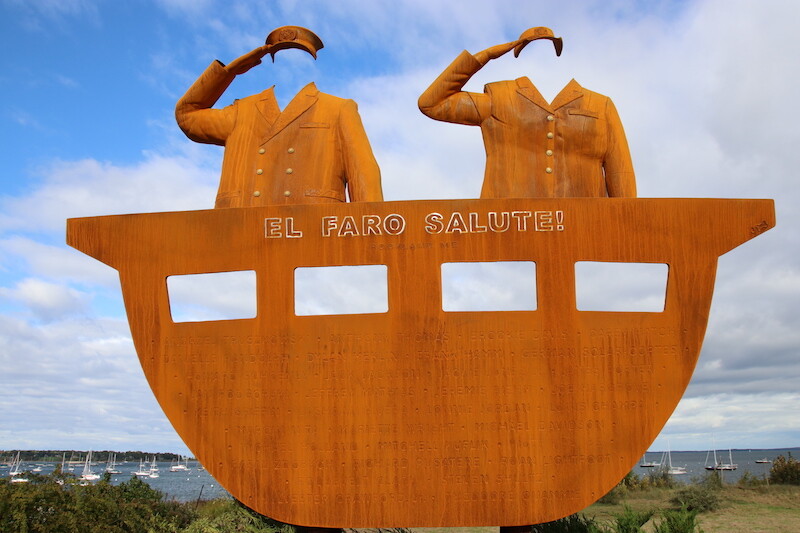
It is my distinct pleasure to compose this post about the “El Faro Salute!” memorial overlooking the magnificent harbor in Rockland, Maine. My pleasure derives from my communication with the memorial’s creator and artist JBONE (the artist formally known as Jay Sawyer). All of the photographs and web site links are courtesy of JBONE, with the exception of the photograph of the ship itself. JBONE is a native of Rockland. He graduated from the Maine Maritime Academy, moving on to a career in the US Merchant Marine. He lived the life of the El Faro crew, which is evident in simply contemplating his design of the memorial – loyalty to ship and shipmates. I encourage all to visit the attached web links and videos relating to the memorial – and to JBONE’S artist web site, which add more background to this memorial and to his other fascinating art.

ElFaroSalute-RocklandME

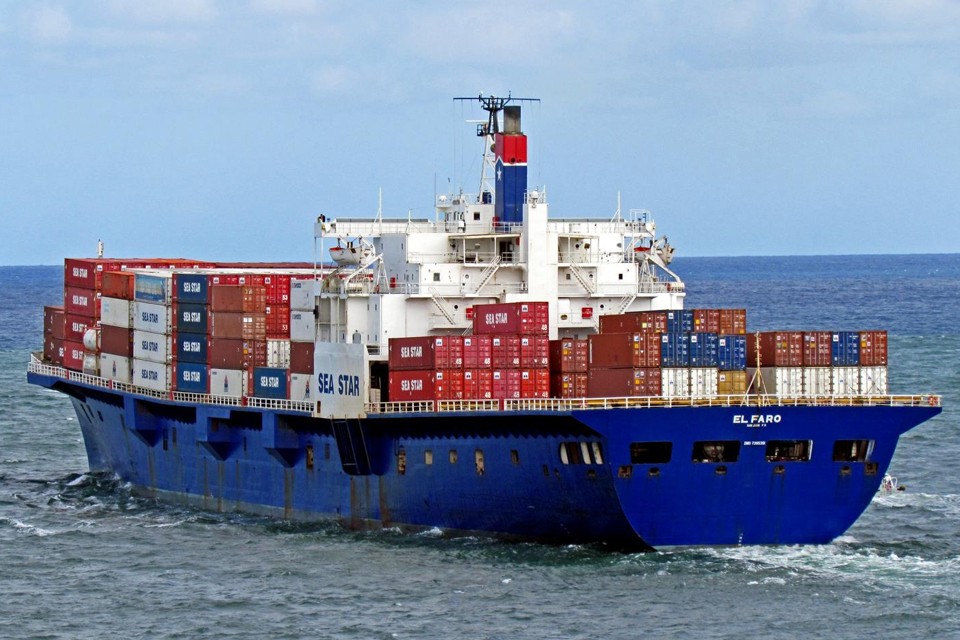
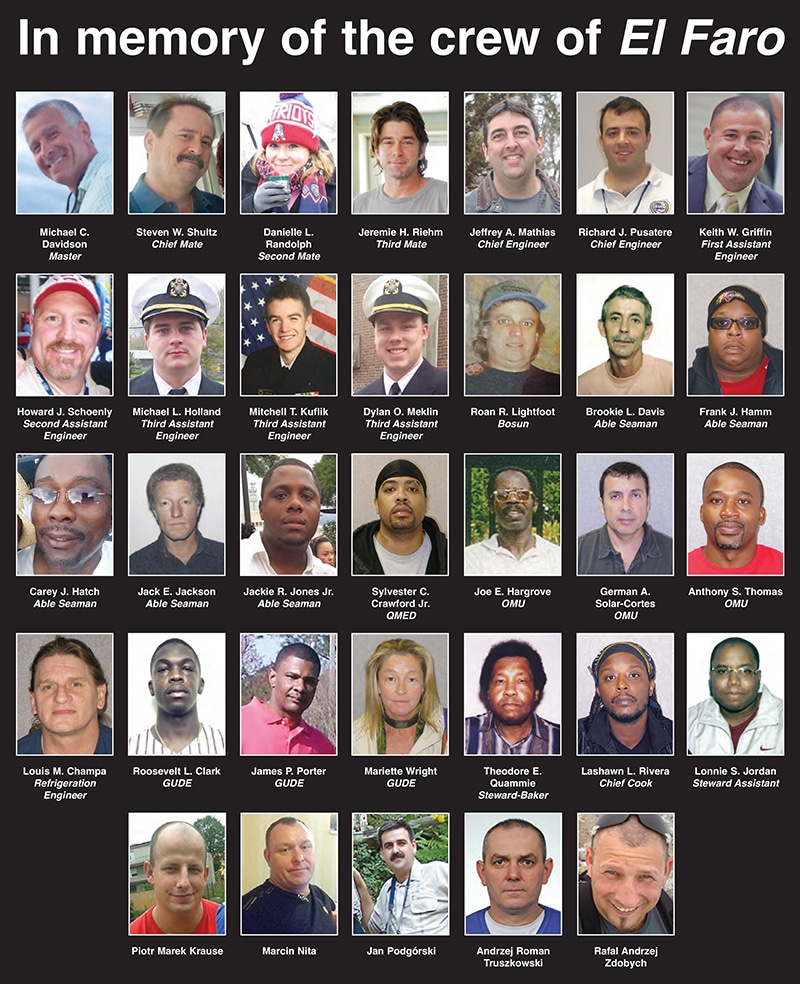
The El Faro (the “Lighthouse”) was a US flagged container ship built in 1975. She was lost at sea with her entire crew on October 1, 2015, after sailing into Hurricane Joaquin on a voyage from Jacksonville, Florida to San Juan, Puerto Rico – a routine voyage for the ship and crew. Her entire crew of 33 perished, several originally from Maine and graduates of the Maine Maritime Academy. The National Transportation Safety Board report of the accident can be found at: https://www.ntsb.gov/investigations/Pages/DCA16MM001.aspx

Captain William Hoey / MarineTraffic.com

Jay Sawyer (the artist now known as JBONE) spent seven years designing, creating, and installing this memorial on what can only be described as an amazing location overlooking Rockland harbor and the Atlantic beyond. The male and female mariners salute you and their shipmates as they sail into their future. Below those figures the visitor can look through the stern portholes of the sculpture to the harbor and the Atlantic Ocean in the distance – the location of the final resting place of the El Faro crew.

Who better to tell the story of the memorial than the artist. Attached are two pdf documents written by the artist himself. Imbedded in two of the photographs within the first document (Glorious Day of Remembrance) are links to video interviews with JBONE. I encourage everyone to view the interviews.

Another fascinating video covering the 10th anniversary of the El Faro loss can be found at https://www.youtube.com/watch?v=74g91-e0Eeg. I especially appreciated the effect of the memorial on the families of the El Faro crew.

Any lost at sea memorial is essentially about precious lives cut short. Please remember those on the El Faro now standing permanent watch on the sea they loved and sailed.

And last, but certainly not least, please visit the JBONE Studio website at https://studiojbone.com. You will learn more about the El Faro memorial and have the opportunity to view the artist’s fascinating other work.

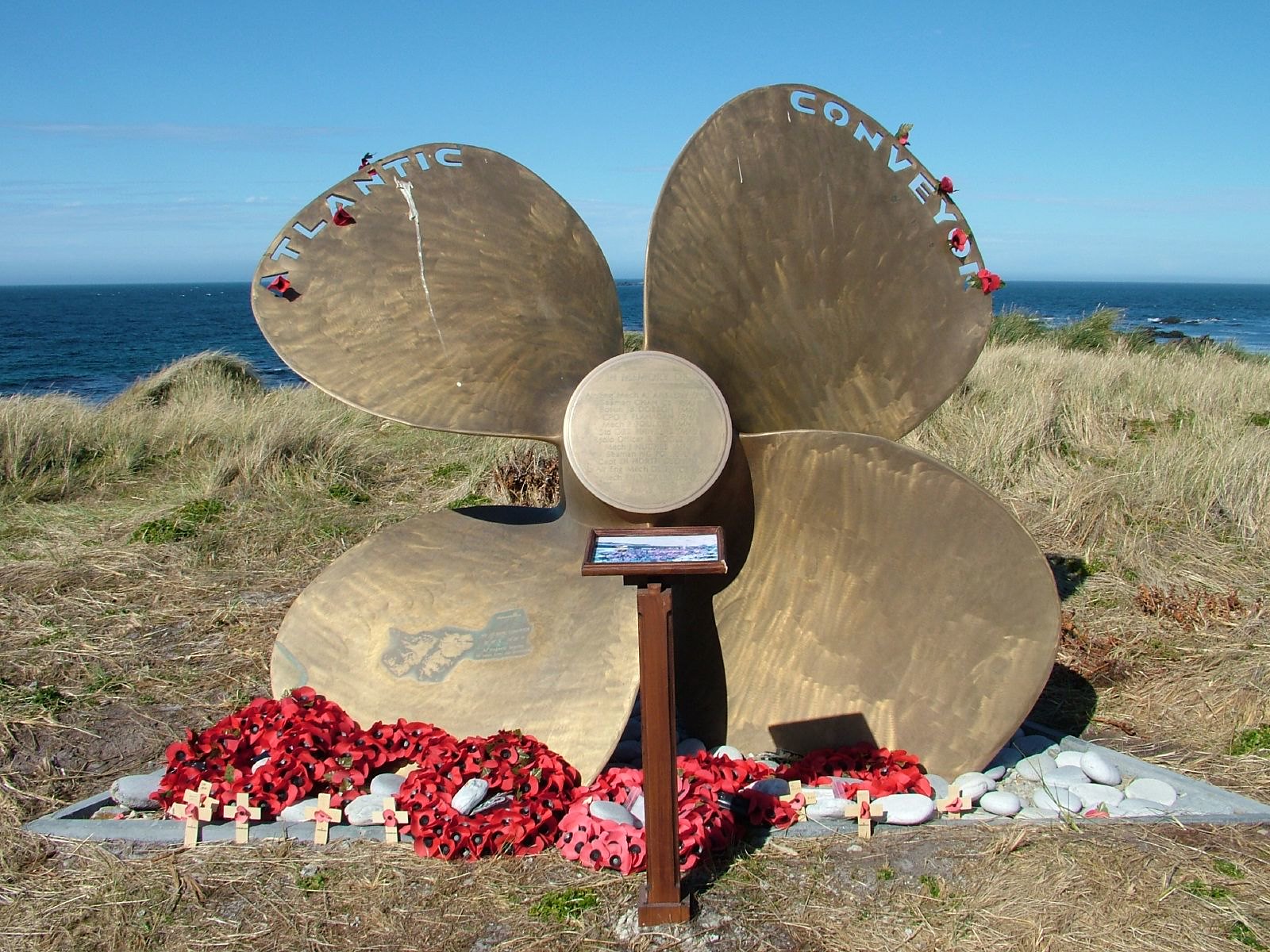
Atlantic Conveyor (East Falkland Island)

Aug 19
Posted by Dan Filed in Uncategorized

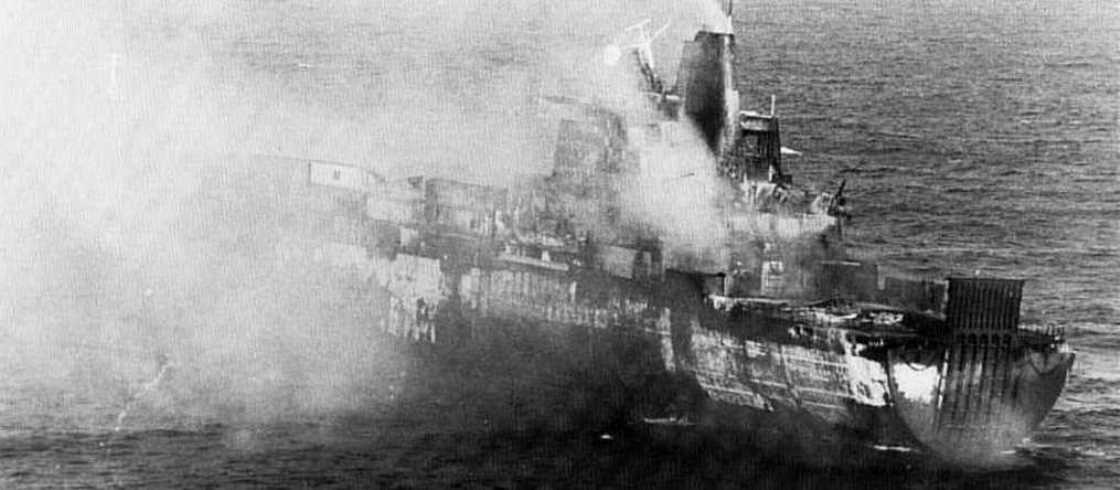
The Atlantic Conveyor was a British container ship transporting military and humanitarian supplies to the Falkland Islands during the 1982 conflict between Great Britain and Argentina. The ship carried Wessex and Chinook helicopters, as well as Fleet Air Arm Harrier jets. On May 25, 1982 the ship was hit by several Argentine Exocet missiles. The initial attack resulted in the loss of 12 lives, including the ship’s master. The ship eventually sank on May 28, 1982, ninety miles offshore from East Falkland Island. All the ship’s deceased were lost at sea or remain within the sunken hulk of the Atlantic Conveyor.

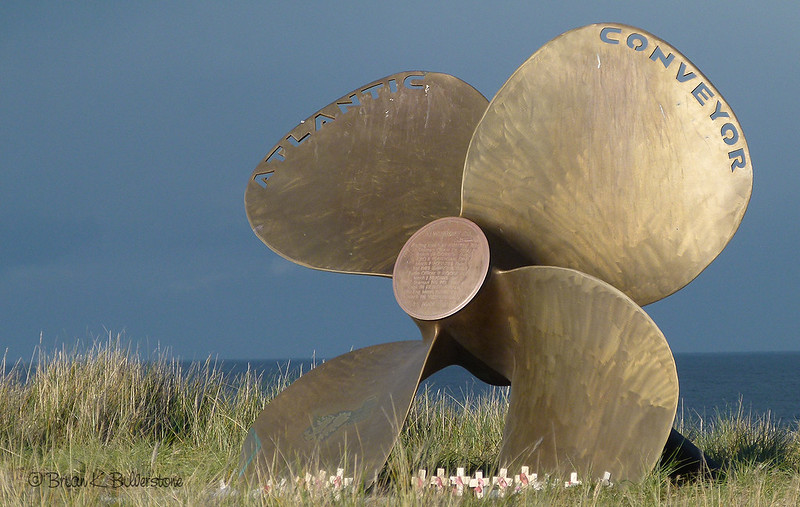
The memorial is located on East Falkland Island. The propeller shaft points directly to the spot of the sunken remains of the ship – 90 miles offshore. The names of the 12 crewman lost at sea are engraved on the propeller hub.

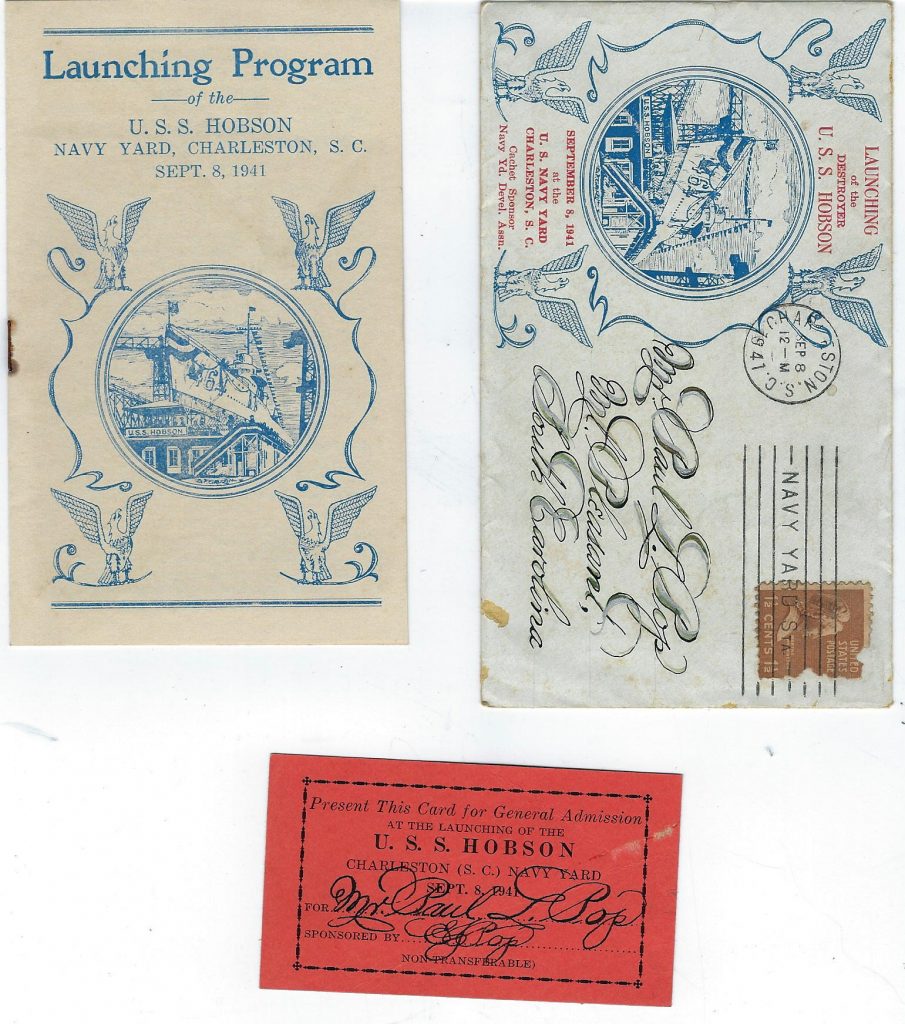
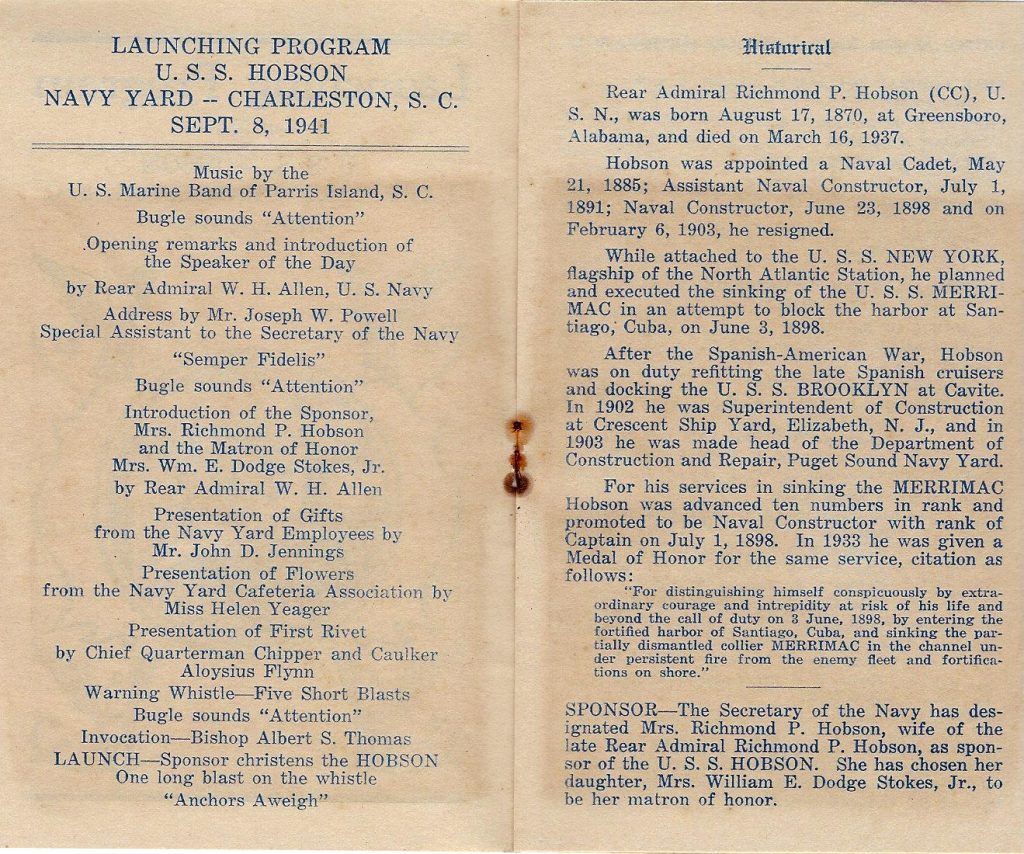
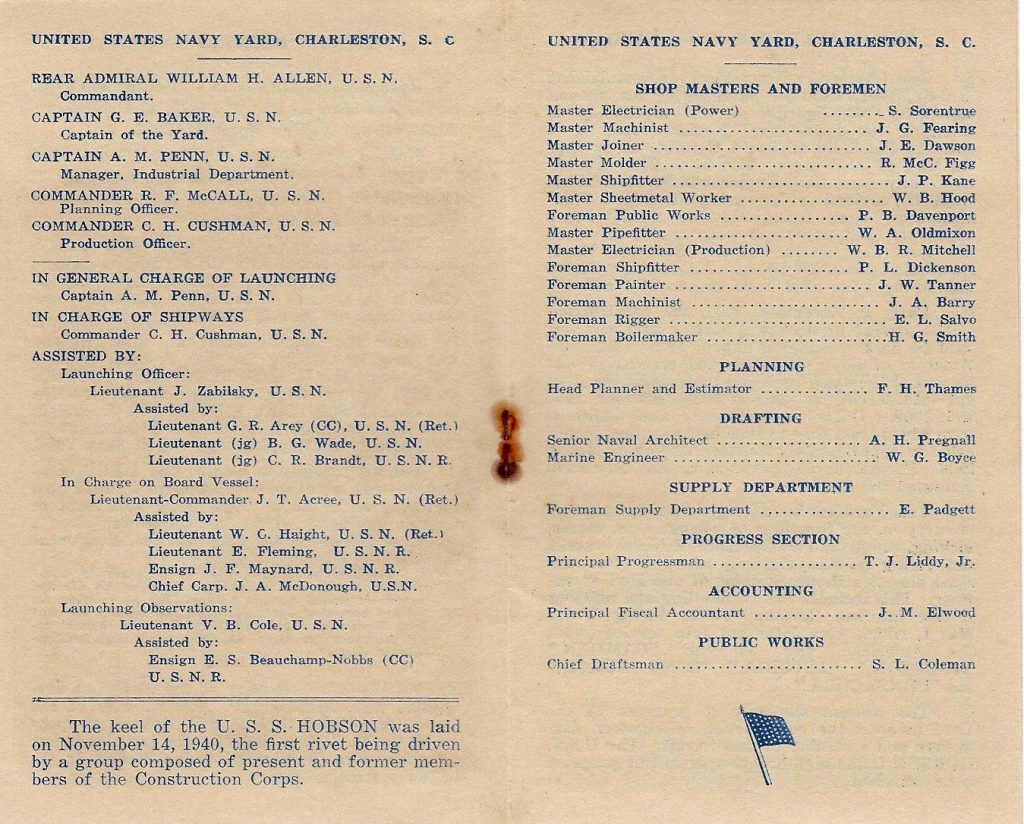
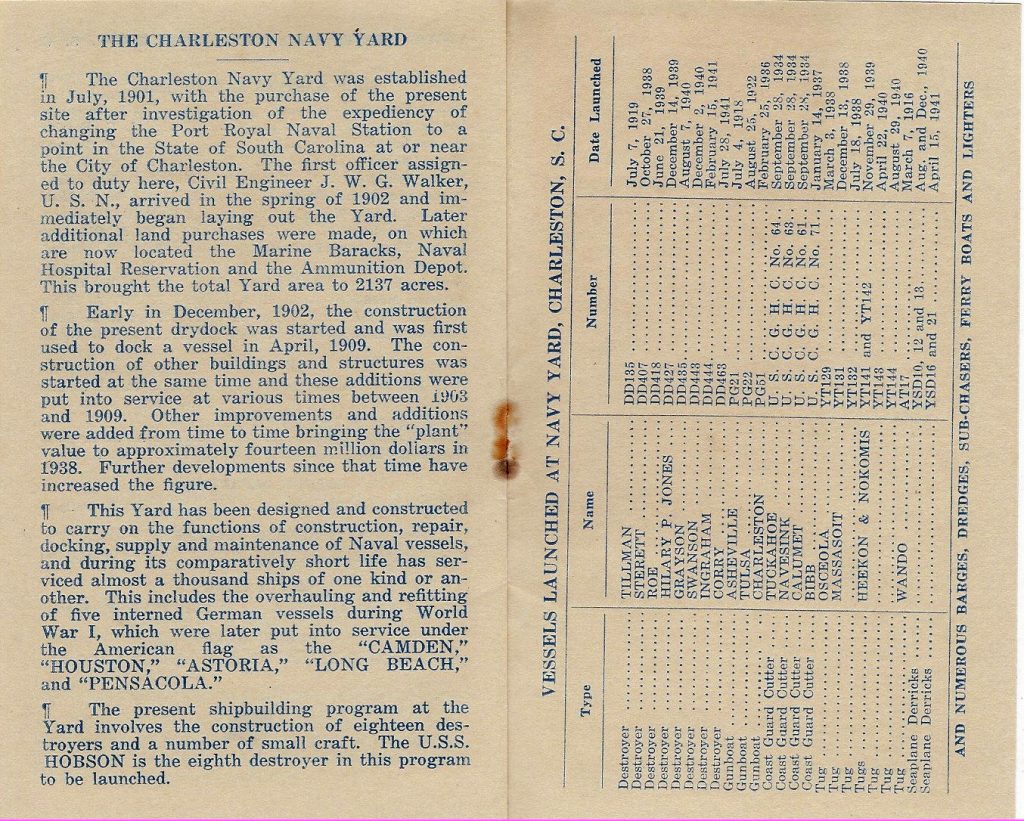
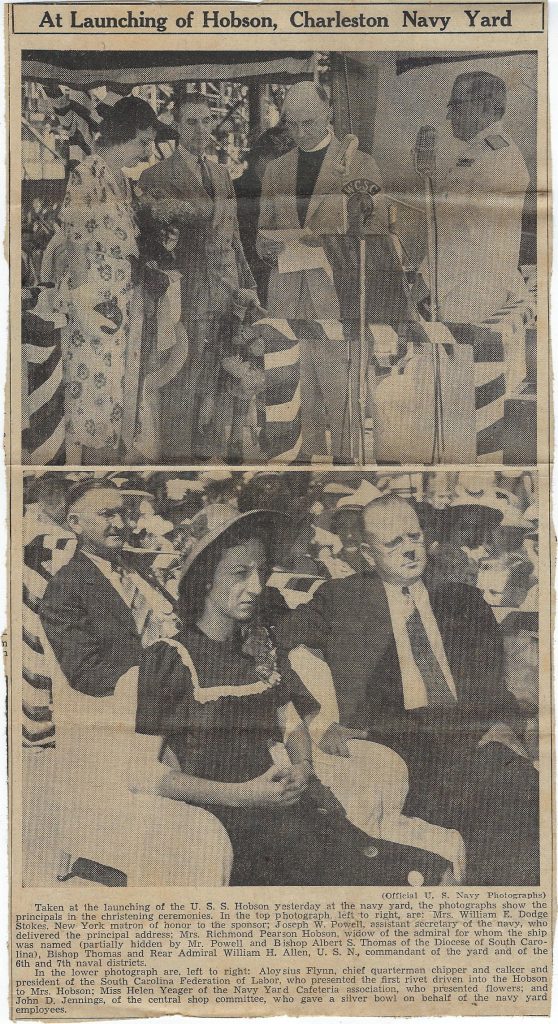
U.S.S. Hobson Launching Program – All Images Courtesy of David O. Whitten

Mar 25
Posted by Dan Filed in Uncategorized

All the above images are courtesy of David O. Whitten and his wife June. Mrs. Whitten’s father, Edmond Pop, was a ship fitter in Charleston during WWII – one of the countless skilled civilians who efforts were as important to the war effort as any soldier, sailor or marine. My sincere appreciation to Mrs. Whitten and her father for this material.

Please read Mr. David Whitten’s fascinating account of serving on an honor guard at the U.S.S. Hobson Memorial in the previous post on this blog. You will not be disappointed.

USS Hobson continued again

Mar 24
Posted by Dan Filed in Uncategorized

USS Hobson Memorial (David O. Whitten, Ph.D.)

“DD 464, the USS Hobson, built in Charleston, was a veteran tin can (destroyer) with action stars aplenty. She survived World War II but sank in friendly waters after colliding with aircraft carrier USS Wasp. Hobson was steaming in formation 700 miles west of the Azres on the night of April 26, 1952. When the ships turned into the wind to allow Wasp to recover aircraft, Hobson crossed the carrier’s bow from starboard to port and was struck amidships. The force of the collision rolled the ship over, breaking her in two. The cost in lives was 176 officers and men. Loss of Hobson meant more than the deaths of sailors and the sinking of a ship. Dozens of children were orphaned and women widowed, some of the wives had suffered years of war only to lose their husbands in a peacetime accident.

The Hobson and her crew will not be forgotten so long as the pink marble memorial stands tall at the corner of White Point Gardens across the street from the Fort Sumter Hotel on Charleston’s beautiful battery. The hotel was converted into a retirement home long ago. The marble, weathered and no longer the dainty shade of pink she displayed at unveiling, bears silent witness to the loss.

My family had moved from Mt. Pleasant, South Carolina into Charleston during the summer of 1958. Because I often drove along the battery coming and going from our house on South Battery, I always studied the lovely Hobson memorial. I had read the sad story in the paper and knew that survivors and other caring citizens including sailors of the Wasp had donated the money for the monument, had it commissioned, negotiated with the City of Charleston for the spot for construction. I considered attending the memorial in Apriln but when the appointed Saturday arrived weather was windy and wet. I concluded that dedication would be postponed for better conditions and gave it no more thought until my mother announced that Chief Rhupe was on the telephone.

Rhupe was the US Navy corpsman (paramedic) assigned to the 53rd Infantry Company USMCR. It was Rhupe who did the paperwork when I enlisted in January 1957 and it was Rhupe who helped me engineer my switch to active duty for Parris Island boot camp during the summer of 1957 and back to reserve status at the end of the summer so that I could complete high school. Rhupe was the one member of the I&I staff of Marines held in high regard by everyone, reservists and other active Marines assigned to the company. If something had to be done, Rhupe did it. If Rhupe said it, nobody argued. He was the anchor of the company. A chief petty officer Rhupe was resplendent in his Marine Corps uniforms replete with his chief petty officer’s insignia and service stripes on a single sleeve. He was a handsome man with an athletic build and perfect teeth to show off a terrific smile. In Marine Corps dress blues he outshone any other Marine in view.

So what did Rhupe want with me this rainy Saturday morning? “Whitten!” he said before I could utter a word. He heard me pick up the receiver. “Yes sir?”

“Climb into your green uniform and meet me at the Hobson memorial in twenty minutes, I need you to round out a color guard! No time to discuss it, get moving!”

“But Chief,” I blurted, “why are you calling me?”

“We had everything set,” he said in exasperated tones unusual for him, “when one of the men collapsed during rehearsal out here at the training center. His appendix ruptured and we had to rush him to the hospital and that leaves me a man short for the twenty-one gun salute. I called you because I know I can count on you to show and you are smart enough to learn your part without a rehearsal.”

“What about a rifle?” I foolishly asked.

“Whitten! Do you think I haven’t taken care of that? I have the rifle and cartridge belt and I’m sitting here adjusting the belt to fit you. Tell me you’ll be there and I can get onto something else.”

“You wouldn’t call me if there were another option?” “You know I wouldn’t!”

-1-

What about the rain Chief?”
“We go on at ten rain or shine.” He hesitated. “The rain will stop for this!”
“I’ll see you in twenty minutes.”
“Good!”
We rang off and I hurriedly told my mother what I was about and she helped me get into the

heavy wool green uniform. I drove the several blocks to the Fort Sumter Hotel, parked along South Battery and walked through to the monument site. Rhupe and the Marines were climbing out of cars parked along the side street. He grabbed me from behind because I had not seen him. Before I could say anything he slung a cartridge belt around my middle and clasped it. Of course he had sized it perfectly. I had an M1 in my grasp in another second along with a copy of the program. I looked over the list of events, folded the paper and slipped it into the inside pocket in my uniform blouse.

“There are three blank rounds and an empty clip in the first right pocket of the cartridge belt. When you get the order to lock and load put them into the rifle.” He then explained in detail what I was to do where I was to march, how I was to fire, and so on. “You did an honor guard last year, didn’t you?”

I nodded.

“I thought so! This is pretty much the same deal.” He showed one of his great smiles. “It is two minutes to ten and the rain has stopped!”

“I knew it would Chief, after all, you said it would!”

He slapped me on the back and shoved me into my place in the formation, uttered a command and we marched across the street, along the sidewalk to the monument and off to the side so that our backs were to the Ashley River.

The Gardens hosted about a hundred men, women, and children. Some of the women held infants. Everyone was sad eyed and many were weeping. Rhupe was in charge. I learned later that he had put together the honor guard with volunteers. No one was there under orders and no one was getting paid for this performance. I was the only member of the reserve company, the other Marines were from the Charleston Naval Shipyard guard mount.

Several men spoke to the group. No one held the platform for more than a few minutes. The theme was constant: the Hobson had been a magnificent ship with splendid crew. The nation and the Navy mourned their loss..

The weather was threatening and the speakers knew that this crowd, children and all, would stay any downpour to honor their lost family members, so they kept everything moving rapidly.

After about fifteen minutes of speeches during which the honor guard stood at attention, we were called to port arms and ordered to lock and load. I slipped the empty clip into the rifle and fit in two of the blank rounds. The third round I slipped into the chamber.

“Twenty-one gun” (preliminary command), “salute!”
We pulled rifles into our shoulders.
“Unlock!” I took off the safety as did the other six Marines. “Fire!”

We discharged the weapons in a cloud of smoke and noise.
“Reload!”
We pulled rifles out of our shoulders and returned them to the port position and pulled the

receiver home to remove the discharged round and put a fresh one into the chamber. Without an adaptor for blanks the M1 will not fire semiautomatically, we had to reload manually. I have never seen a twenty-one gun salute fired with M1s with adaptors, perhaps because the manual of arms used was unchanged from the one written for the bolt-action 1913 Springfield rifle.

“Aim!”
Rifles back into firing position.
“Fire!”
And a repeat produced the required twenty-one rounds.

-2-

We returned to attention while the field music (bugler) played taps. There was still no rain but there were no dry eyes.

We were dismissed and the show was over, but was it?

The crowd converged on the participants in the dedication. We were hugged and thanked by everyone. One of the women hugged me in tandem with the child she was holding. Rhupe ordered us to release the empty rounds from our rifles and as we did so the empty clips jumped out with their characteristic zing. The people around us were picking up the empty shell casings and clips and sharing them around, mementoes of the dedication. Everyone was appreciative of our willingness to perform this small favor for the survivors of Hobson.

About two minutes after we finished the rain started to fall again and the crowd made for their cars. Rhupe took the cartridge belt from me and I handed him the rifle.

“Thank you Whitten!”
I smiled and turned for the run to the car.
“Oh, Whitten?”
I turned back. “Savor this moment! There is never going to be another time when you will fire

a Marine Corps rifle without having to clean it afterwards!” I am sure that Rhupe cleaned that weapon himself.

We both laughed. He began directing his men into cars and I ran toward mine. Just in front of my mother’s 1955 Plymouth was a large white car. A man and woman with grey hair were trying to get two young children into the back seat with the help of a younger woman. I heard the man say as I hurried by, “Yes there was a printed program but I couldn’t get a copy, I asked everyone I saw but there were none to be had.

I stopped. “Excuse me. You want a copy of the dedication program?” The three adults turned to look at me and the children stopped struggling so they could see what was happening.”

The older woman spoke. “Yes, we would very much like to have a copy. Our son . . . her husband . . . their father . . .” She couldn’t finish the sentence.

I unbuttoned the top two buttons on my blouse and withdrew my copy of the paper they wanted. I handed it to the woman who had tried to speak. She took it with the reverence that would be accorded a crown jewel. “Thank you so much!”

The young woman spoke. “You don’t want it?”
“Certainly I want it!” I responded, “but it belongs to you.”
The man grabbed my hand and gave it a shake but said nothing. The older woman just cried

and the little boy, perhaps five years old, still standing in the door frame of the car, leaned out and shouted in his shrill voice as I moved away, “Thanks, Sarge!”

That was a grand salute for a private first class who would not be sarge for another three years.

The Hobson will always be a part of me. I will never forget that wet Saturday morning in Charleston when I joined the families left behind when the US Navy lost one of its own.

-3-
Pamir Continued…

Aug 1
Posted by Dan Filed in Commercial Shipping, Uncategorized

A recent communication from Mr. Phil Short of the Southport Yacht Club of Australia renewed my interest in the Pamir. I quote his comments below:

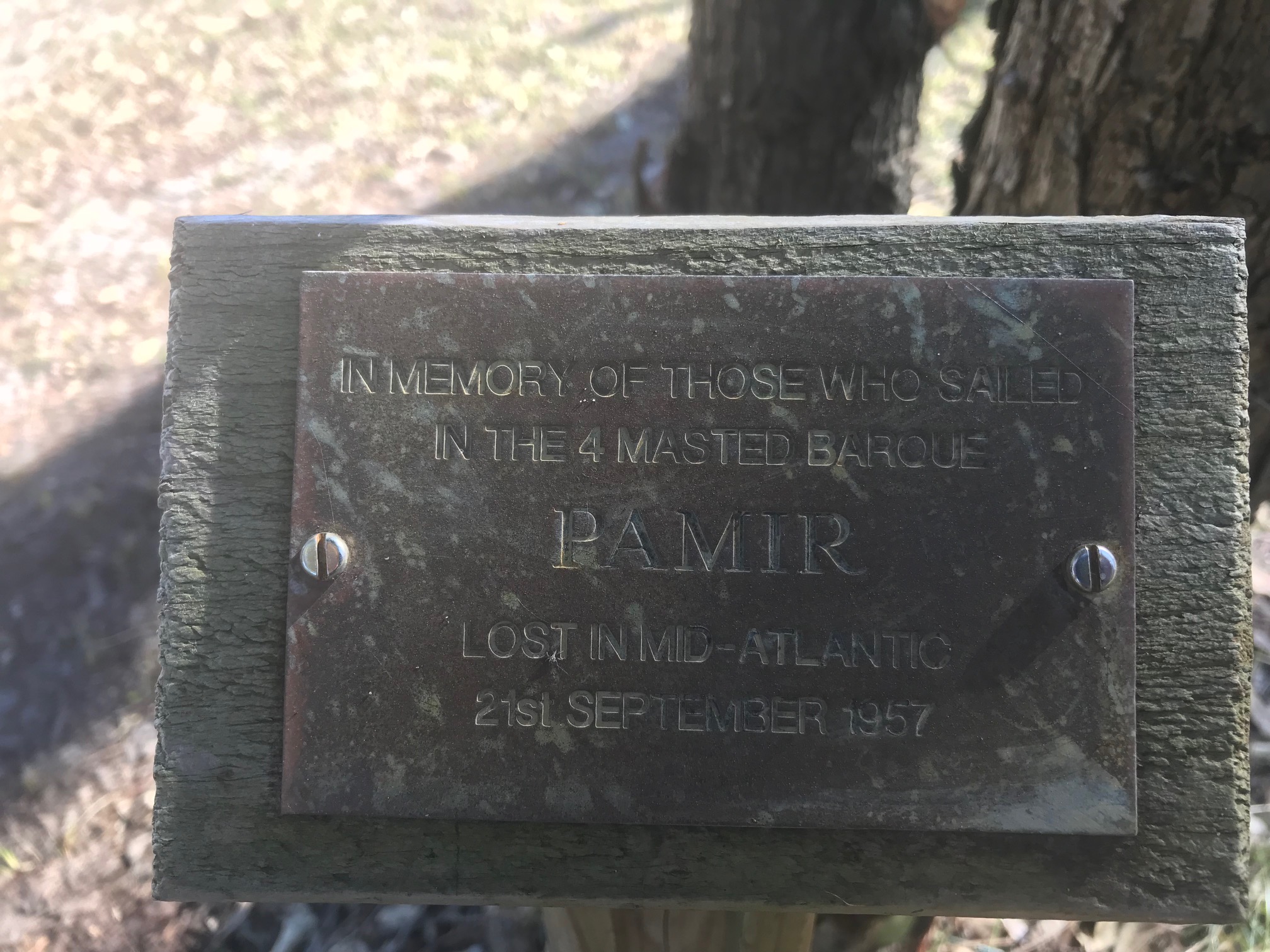
“I have discovered a Plaque well fixed to a tree dedicated to the ships company who were lost on the Pamir, on South Stradbroke Island in Queensland Australia. The area is now in the hands of the Southport Yacht Club. The previous owner’s were the Dux family, oyster farmers in the area. Looking back through Dux family history, they were from Germany.
Would like to know more about the crew, if there were any relation’s to the Dux family onboard? Angie Dux died in 1962?
The club is going to restore the area as a memorial to all lost at sea.”

Phil – I edited a few things that got lost on the internet from Australia to California. Please correct anything I got incorrect. Dan.

If anyone has any information that would be of interest to Phil, please pass it along. I will make certain that it gets to him promptly.

Please remember the Pamir!

11/11/18 Update:

Hi Dan.

Remember some time back we were discussing a Brass Plaque as a memorial of the foundering of the Pamir in 1957 at the Southport Yacht Clubs out-post on South Stradbroke Island well we have come across the person who fixed the plaque to the tree- see below. 

Bruce Duncan had been a very active member of the Surfers Paradise Rotary Club and Volunteer Marine Rescue for over 30 years and was a sailor onboard the Pamir.  Bruce unfortunately passed away a couple of years ago, however it has been informed to the Club that Bruce was responsible for placing the below plaque at Dux Anchorage. The plaque was placed at Dux as part of a Pamir reunion here on the coast in the mid 1980’s. Bruce was a very active member of IYFR (International Yachting Fellowship of Rotarians) and stood as a World Commodore at one stage.  

Thank you to our wonderful Club members who provided the below details regarding the mysterious plaque located at Dux Anchorage. Such a wonderful and in sighting story.

Phil Short


Trinidad Head, California

Aug 28

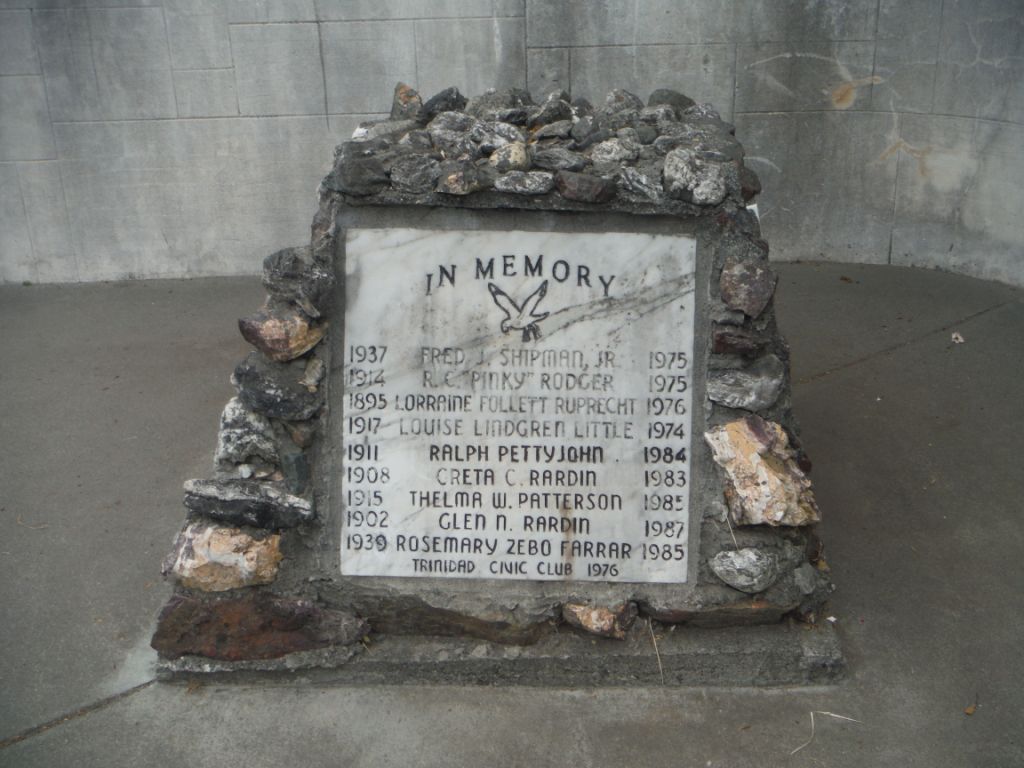
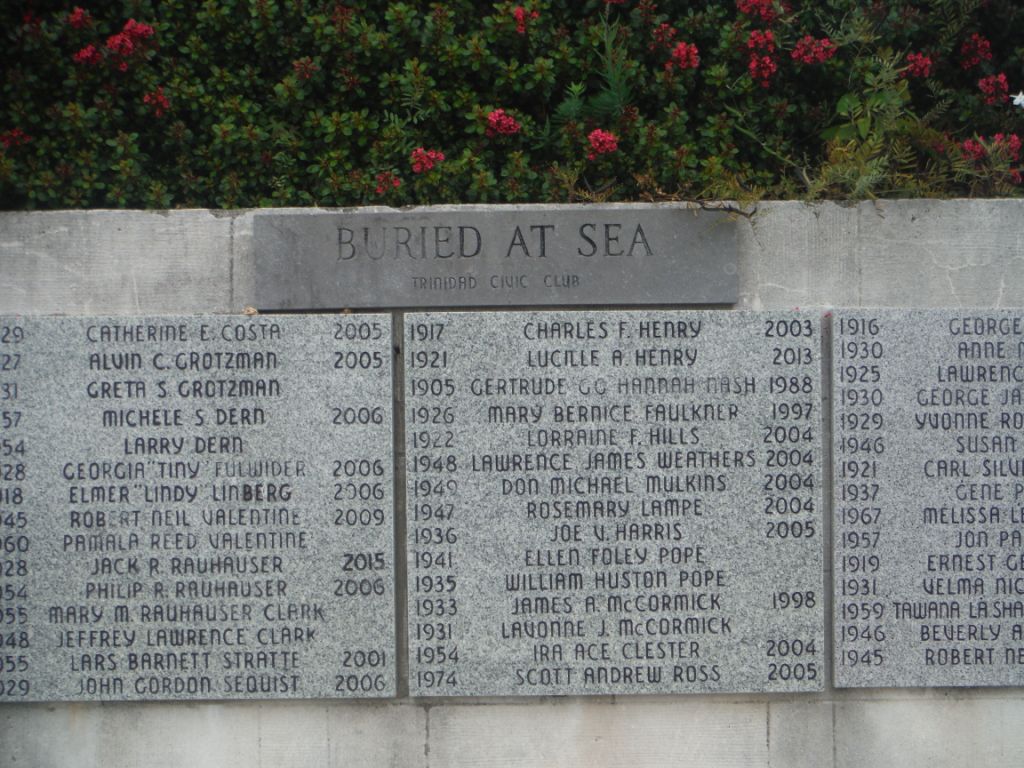
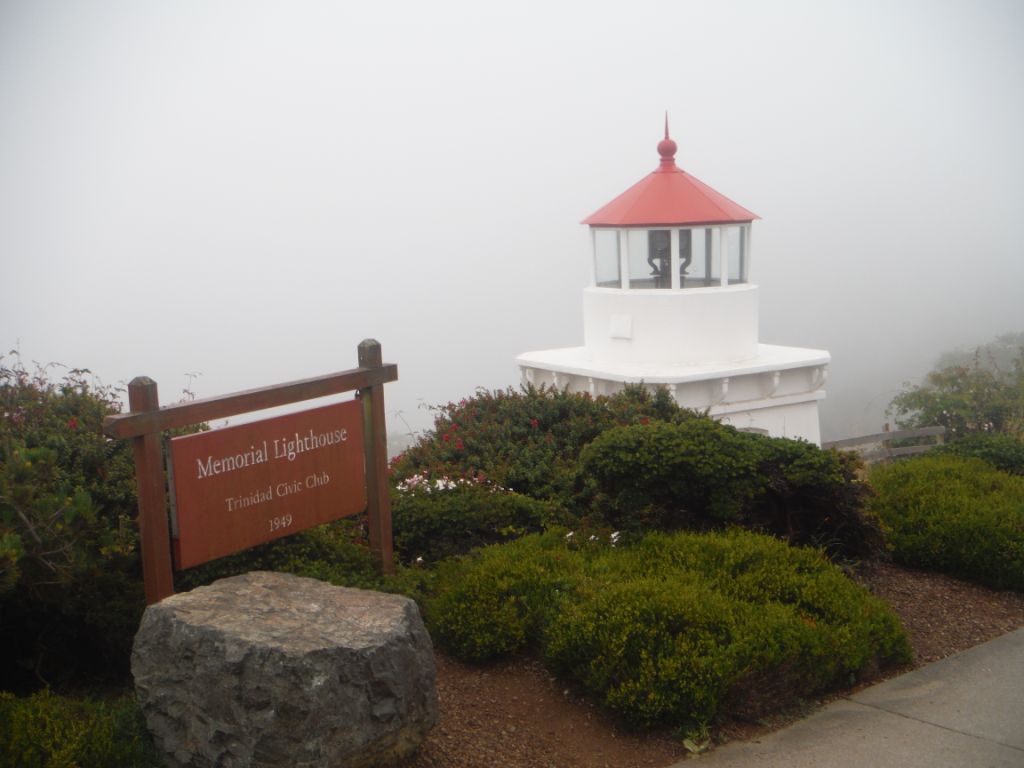
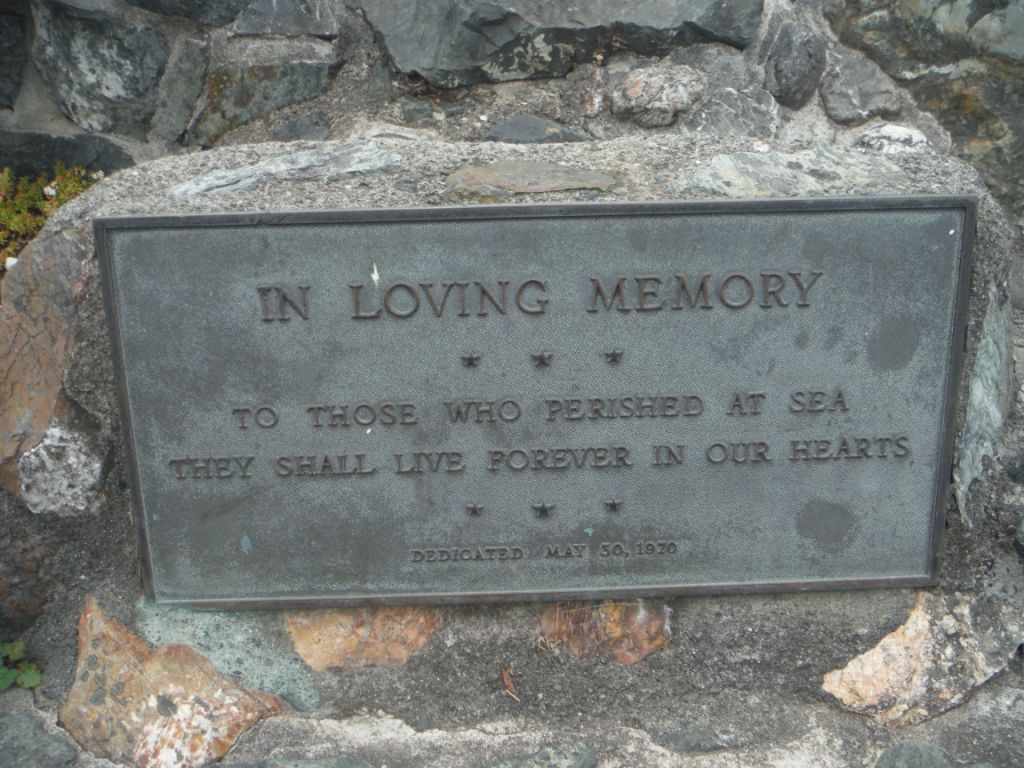
DSCF0906Old friend, former naval officer, and past contributor to this blog Bob Schnell (see March 2011 U.S.S. Roosevelt post) send me the photos for this post.

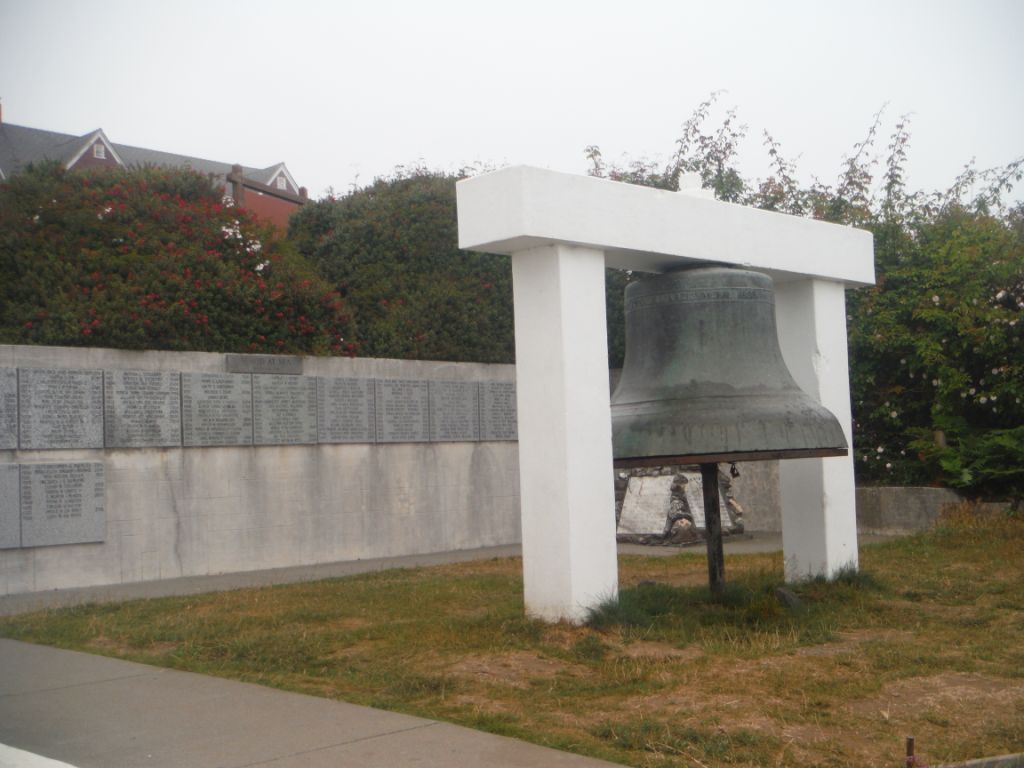
Trinidad Head, California is located in Northern California – north of the cities of Eureka and Arcata. The area has a long maritime history, from fishing to the shipping of redwood lumber to the large ports of the west coast. Below the Trinidad Head lighthouse is a memorial to those lost at sea from the local area. One addition to this memorial that I’ve never seen before is the addition of panels of locals who decided to be buried at sea. I think this adds a nice touch to a memorial located at one of the most beautiful spots in California.
DSCF0901DSCF0903

DSCF0897

DSCF0898

Doris (Dorie) Miller Memorial

Mar 25
Posted by Dan Filed in Wartime Naval & Merchant Marine

SLIDE1

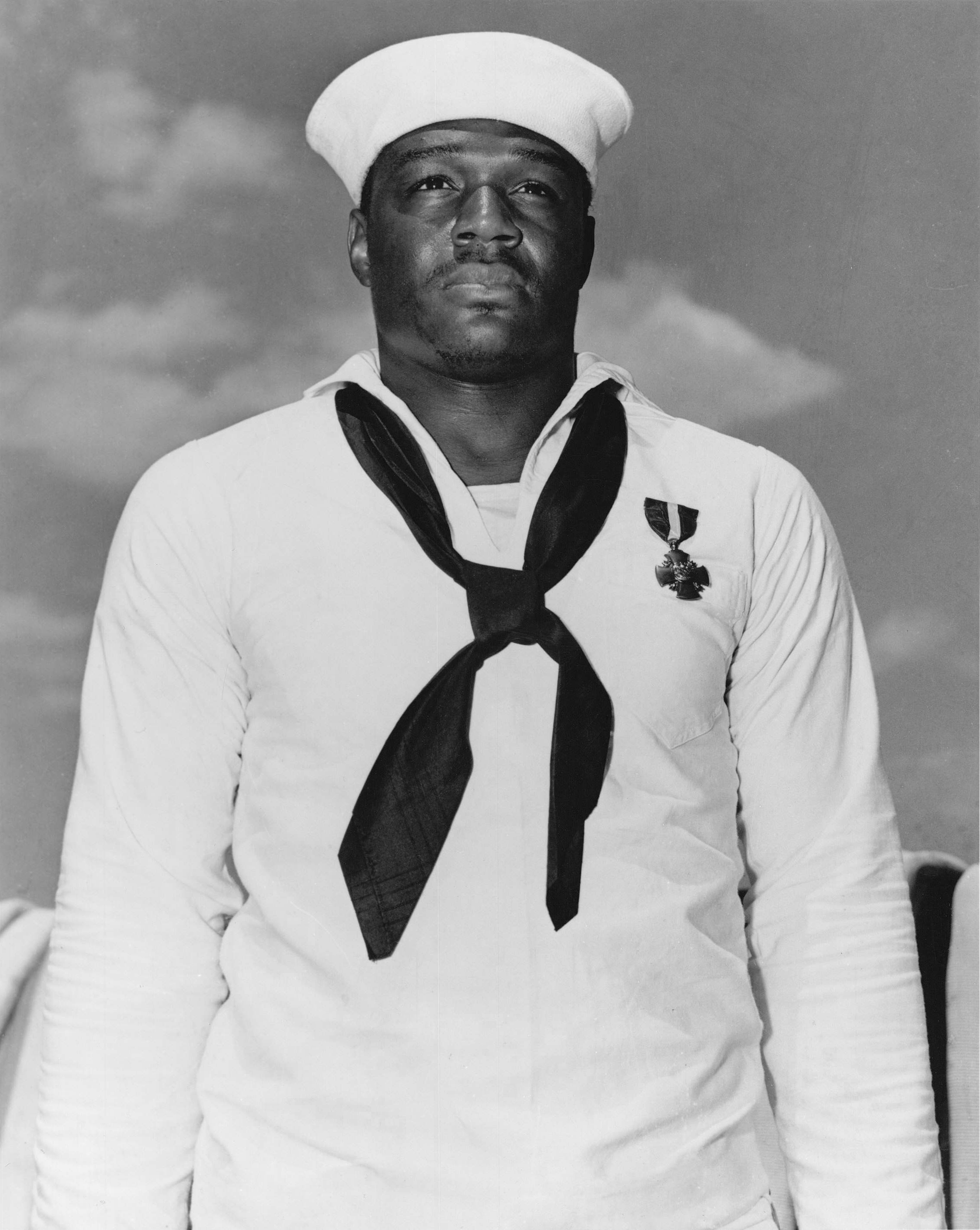
Petty Officer Doris (Dorie) Miller was the first of very many African American heroes of World War II. Miller was born and raised in Waco, Texas, joining the US Navy in 1939 at the age of 19. On December 7, 1941 Miller was stationed aboard the USS West Virginia at Pearl Harbor. Although a mess attendant collecting laundry below decks at the time of the attack, Miller hurried topside, assisting to wounded sailors (including the ship’s dying Captain), participating in damage control & rescue efforts, and finally manning a 50-caliber antiaircraft machine gun. For his courage that day Dorie Miller was awarded the Navy Cross, the Navy’s second highest award for valor, personally presented by Admiral Chester Nimitz. Miller’s story was extensively covered  by the black press and civil rights organizations in the United States. The War Department sent him on a national tour to encourage enlistment. Upon completion of that tour in mid-1943 Miller was assigned to the new escort carrier Liscome Bay. The ship participated in the American offensive in the Gilbert Islands, including the bitter fighting on Tarawa. A fascinating article on Miller’s entire naval career by Michael D. Hull can be found in the February 2016 issue of “Naval History” magazine.

On November 23, 1943 the Liscome Bay was torpedoed by the Japanese submarine I-175. Violent explosions rocked the ship and she sank in twenty-three minutes. Of her 916 officers and crew, only 272 survived. Dorie Miller was lost at sea

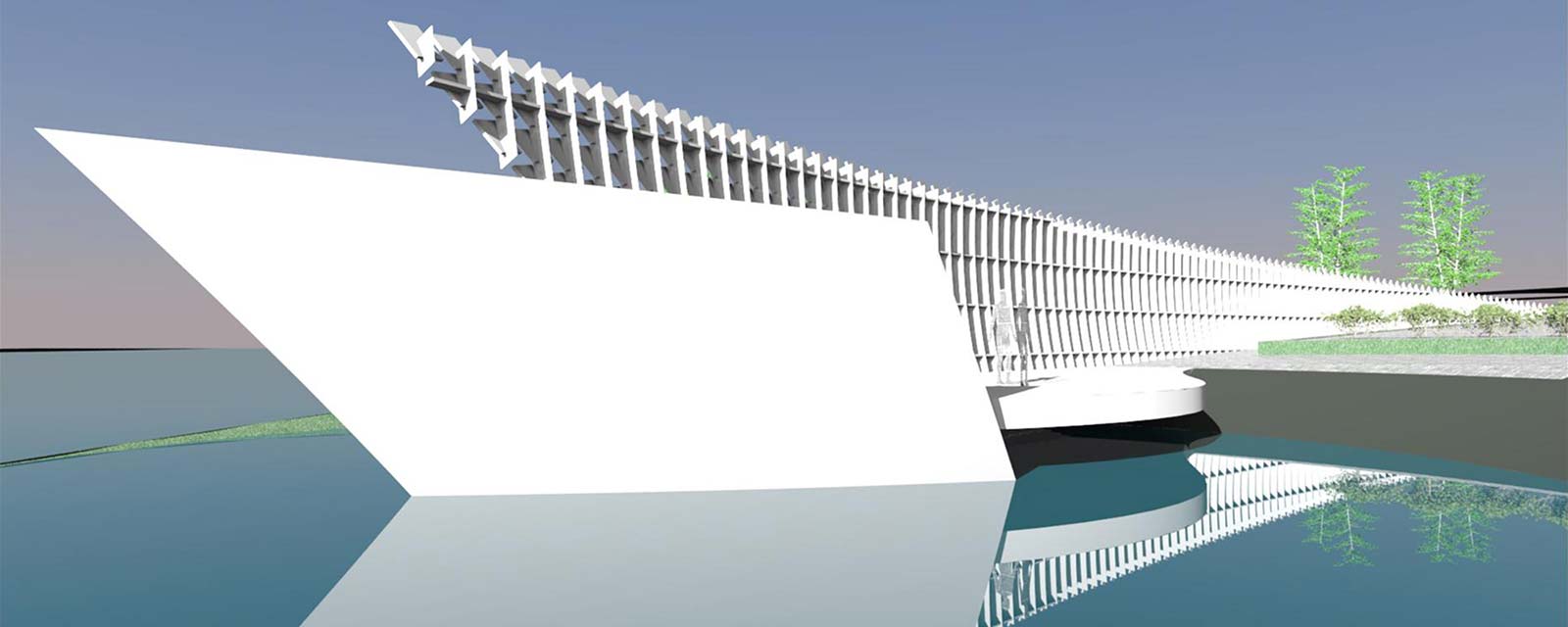
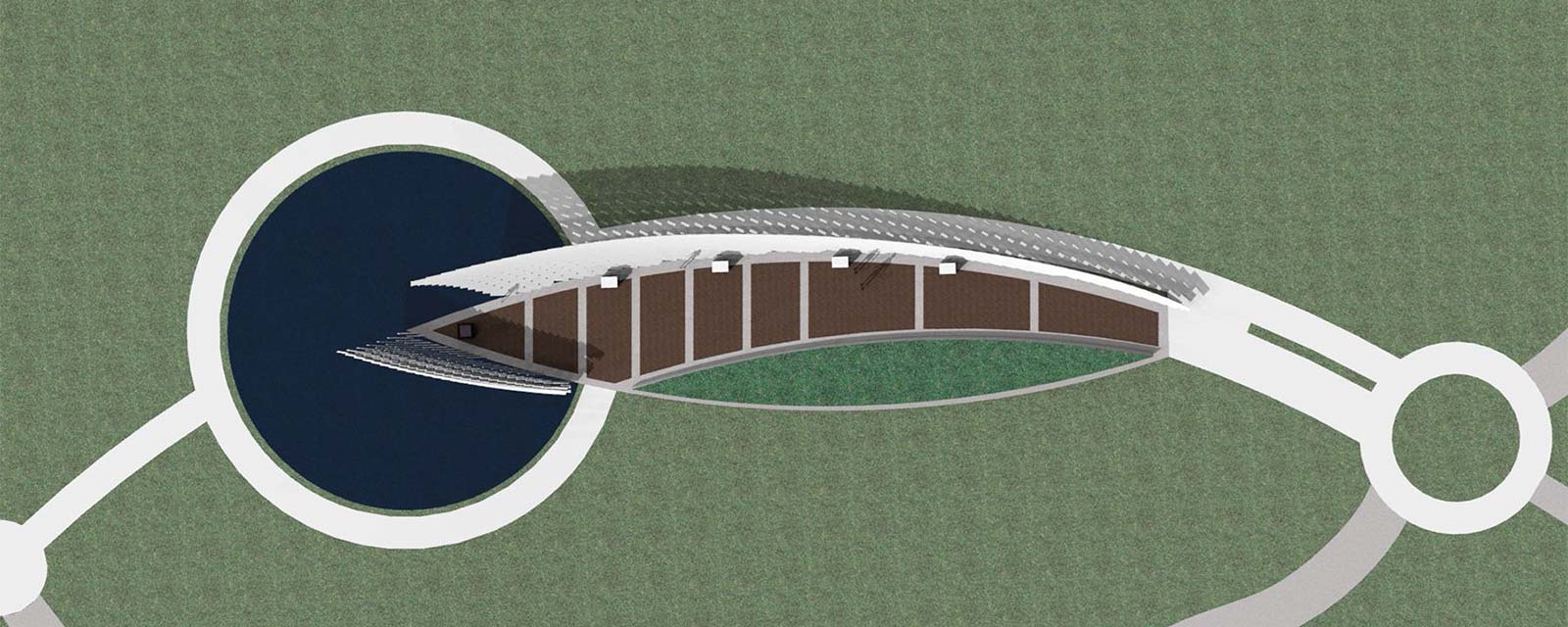
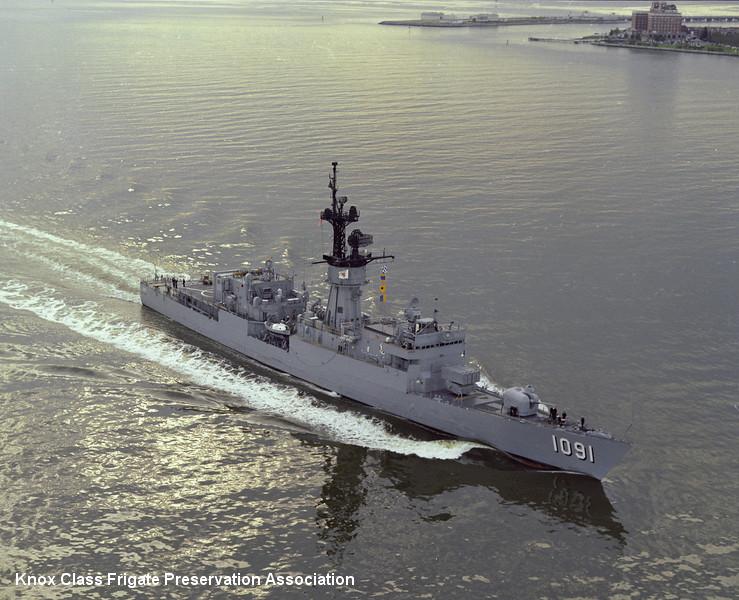
Dorie Miller has never been forgotten. Over the years Miller has been memorialized in numerous ways – schools have been named after him, a Miller Family Park was established at Pearl Harbor, a stamp bearing his likeness issued by the US Postal Service in 2010, and a US Navy Knox Class frigate the USS Miller (DE-1091) was commissioned in 1973. I have recently learned of a stunning new monument being proposed in Miller’s hometown of Waco, Texas. A rendering of the beautiful design can be seen above, and I’ll include other renderings at the end of this post. Fundraising is nearly complete. You can help complete this worthy effort by visiting the beautiful web site for this proposed memorial at http://www.dorismillermemorial.org and by making a donation. The design concept and the approved site are unforgettable. Please help make this memorial to Dorie Miller and the other lost souls on the Liscome Bay a reality.


SLIDE2

Overhead View of the Miller Memorial in Waco, Texas

Doris_Miller

Doris (Dorie) Miller with his Navy Cross

F68C9E87-A130-44F4-8AA50A87404D573E

USS Miller


iPDdMhr

USS Liscome Bay

SLIDE3

Site of the Dorie Miller Memorial

Steamship Northerner, Centerville Beach, CA

Oct 6

IMG_9402

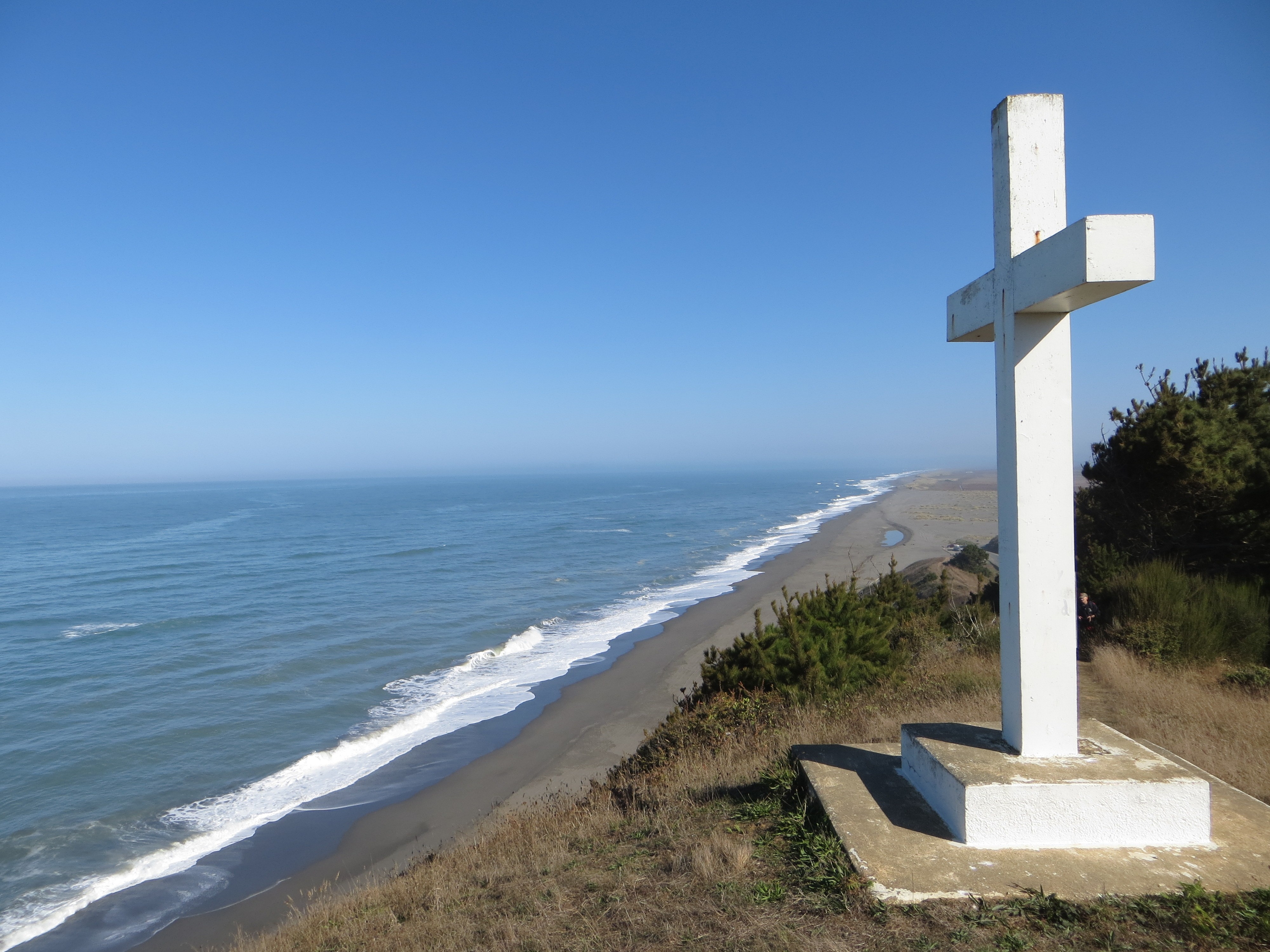
My favorite Lost at Sea memorials are the ones found off the beaten track. Centerville Beach is located north of Cape Mendocino, approximately five miles west of the village of Ferndale. The beach is nine miles long, with sweeping vistas of the Pacific to the west and the redwoods to the east. On most days you’re likely to have the entire beach to yourself. On a tall bluff overlooking the beach is a tall white cross, a monument to the steamship SS Northerner, lost on January 6, 1860.

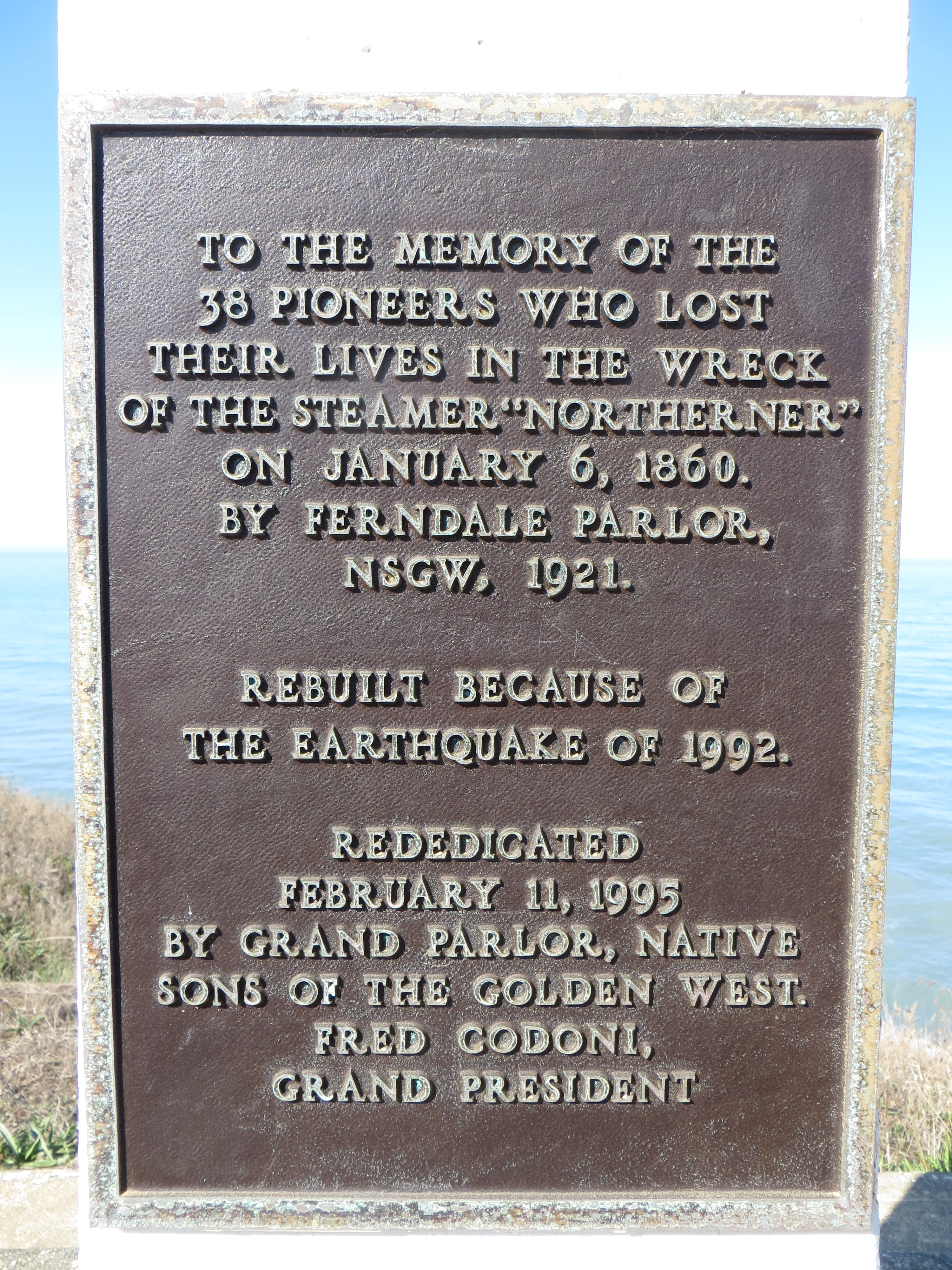
The Northerner was built in 1847 in New York City. She spent her first few years serving the east coast of the United States, but eventually moved to San Francisco, where she established a regular passenger and mail route from San Francisco to the Columbia River and north to Washington. Her last voyage from San Francisco ended when she hit a submerged rock just a few miles offshore from Centerville Beach. The ship was carrying 108 persons at the time of the wreck. 70 people were saved, mostly due to the heroic efforts of the local citizens living around Ferndale. 38 others perished. Some bodies were eventually recovered and buried on a bluff overlooking the site of the wreck. Other victims were lost to the Pacific…

In 1921 a white cross monument was built directly above the burial site of the recovered dead. The original monument was destroyed in an earthquake centered in Cape Mendocino in 1991. Local residents rebuilt the monument and it was rededicated on February 11, 1995. It serves as a stark reminder of the dangers of ocean travel – and as a memorial to lives lost at sea in this remote and most beautiful area.

IMG_9399Northerner_Sailing_Notice_DailyAlta_January_3_1860


IMG_9401


Bodega Head, California

Aug 23
Posted by Dan Filed in Uncategorized

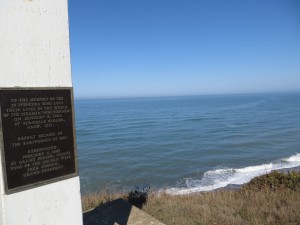
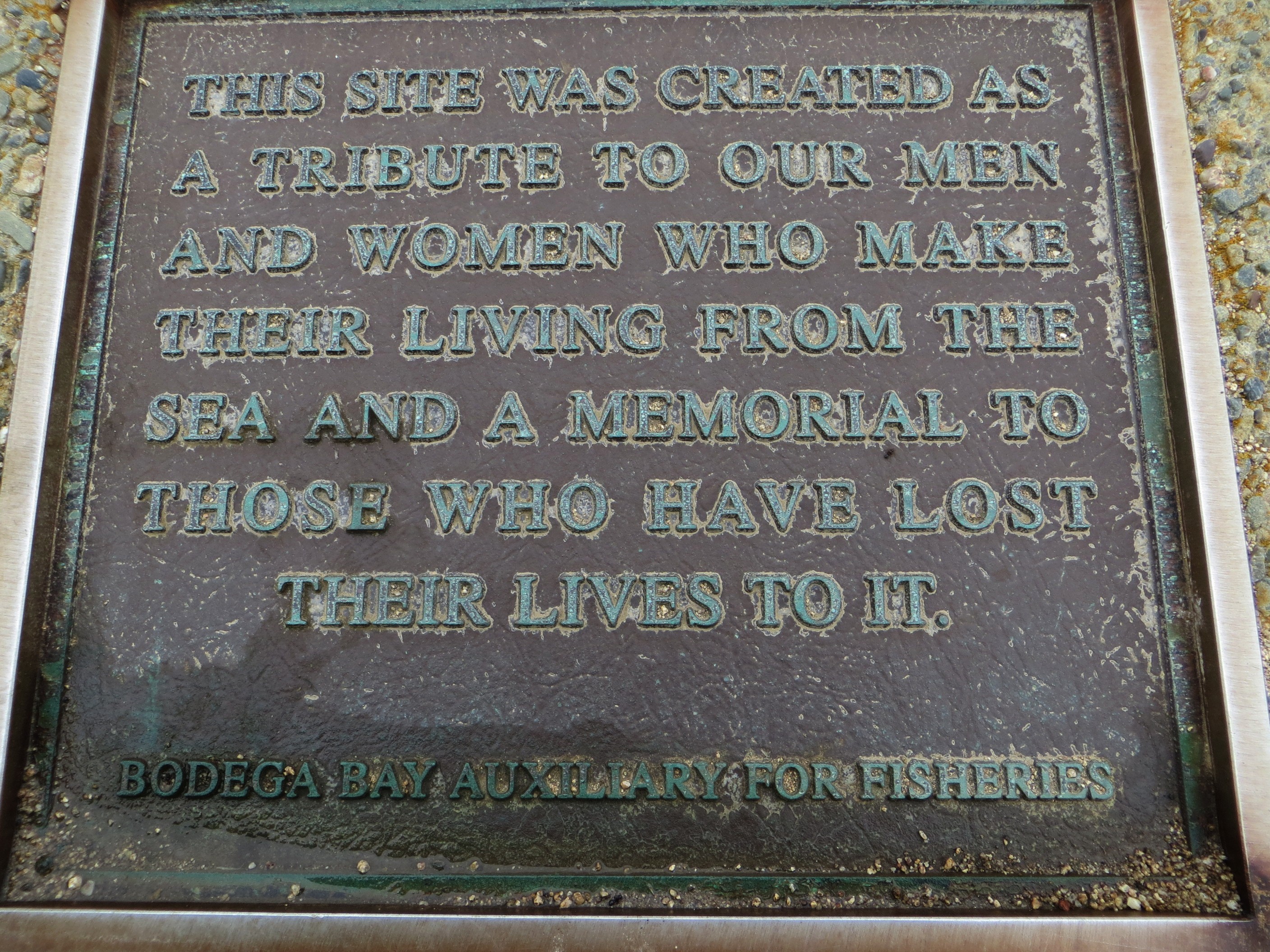
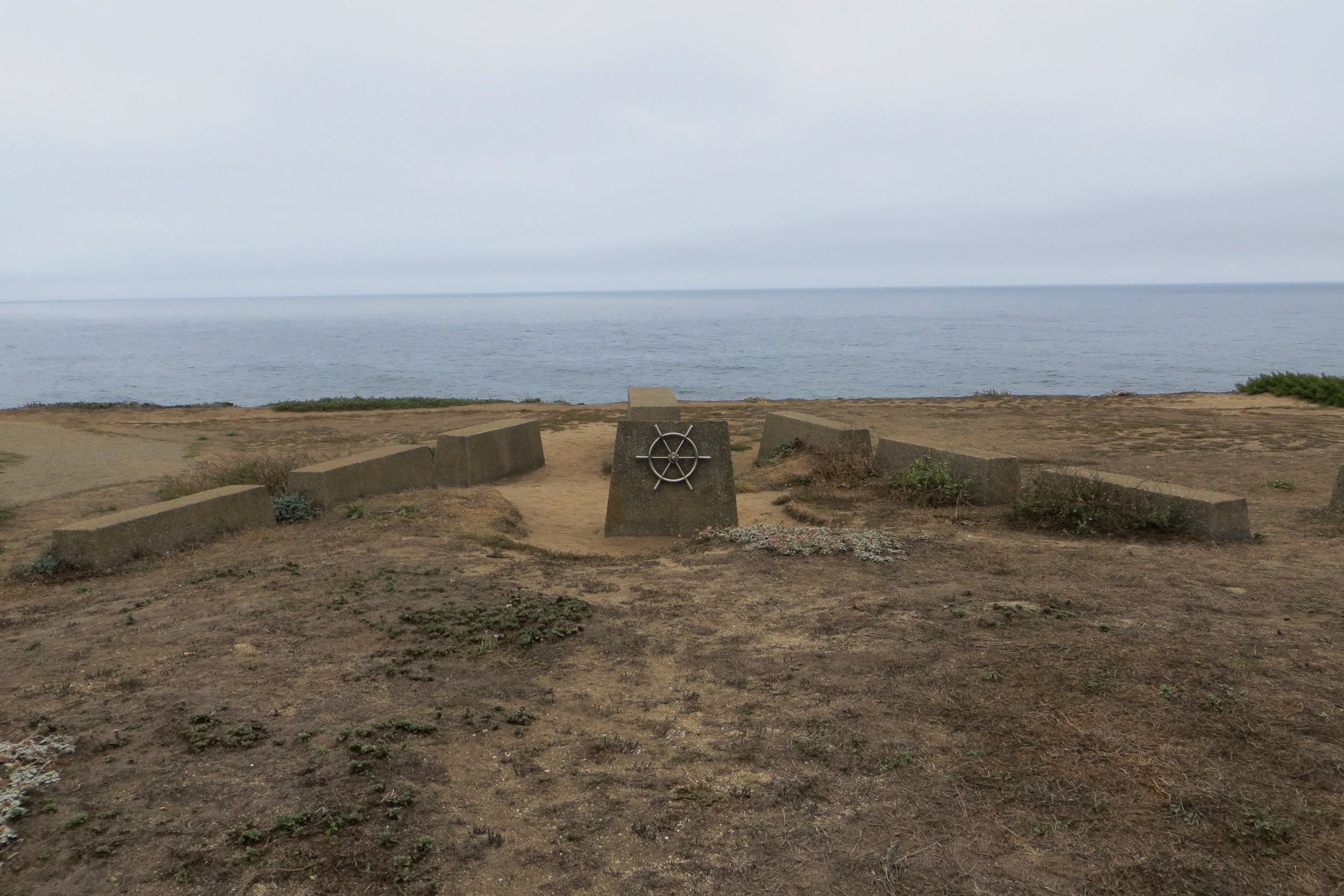
Many of the monuments on this blog are great works of art. Others are quite simple, yet powerful in their own way. This monument is located on Bodega Head, just outside the fishing community of Bodega Bay, California. It looks west over the Pacific. At one time Bodega Bay was one of the largest salmon fishing ports in the world. It is now reduced in size, yet fishing remains a vital part of the local economy. There is seldom a year where local fishermen are not not lost at sea.
IMG_9077IMG_9079IMG_9081

Air France 447

May 25
Posted by Dan Filed in Air Crashes

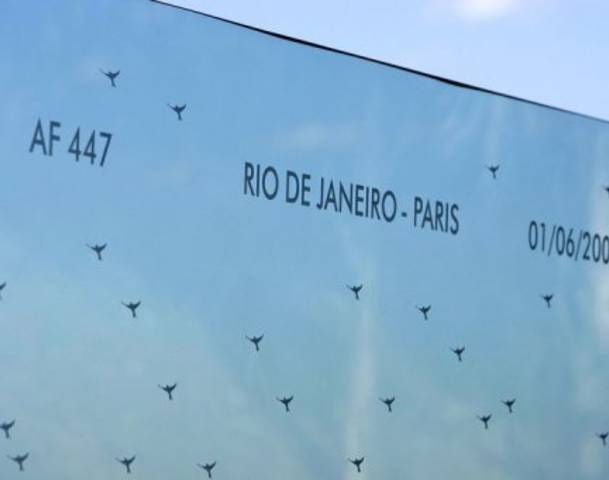
17b9d348d82411e2945c22000ae90026_7The recent disappearance of Malaysia Airlines Flight 370 has drawn comparisons to the loss of Air France Flight 447 on June 1, 2009. Air France was on a flight from Rio de Janeiro to Paris. It was lost approximately 600 miles northeast of Natal, Brazil in the Atlantic Ocean, at a cost of 228 lives. While the precise location of the crash was known almost immediately, with pieces of wreckage and bodies recovered within days, it would take almost two years for the majority of the aircraft to be located on the bottom of the Atlantic and for the flight recorders to be recovered. Analysis of the flight recorder data confirmed early predictions about the cause of the accident. Icing on the aircraft pitot tube sensors caused speed sensors to report incorrect data, at which time the autopilot disengaged. The flight crew became confused by the loss of instrumentation, never fully realizing the exact nature of their situation. The actions of the crew resulted in a stall and a subsequent loss of controlled flight, the aircraft plunging 33,000 feet into the Atlantic Ocean. Recovery efforts over two long years resulted in finding the remains of the majority of the passengers and crew. No remains for 50 people were recovered, however. Those 50 remain forever lost at sea.

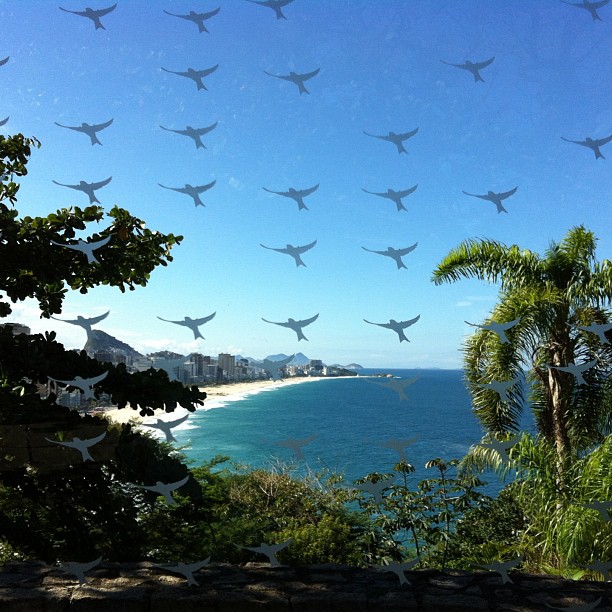
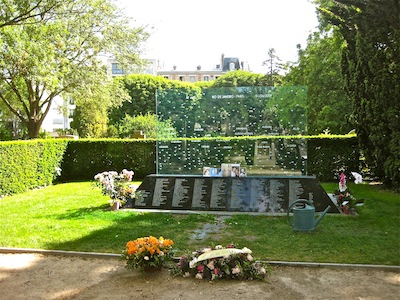
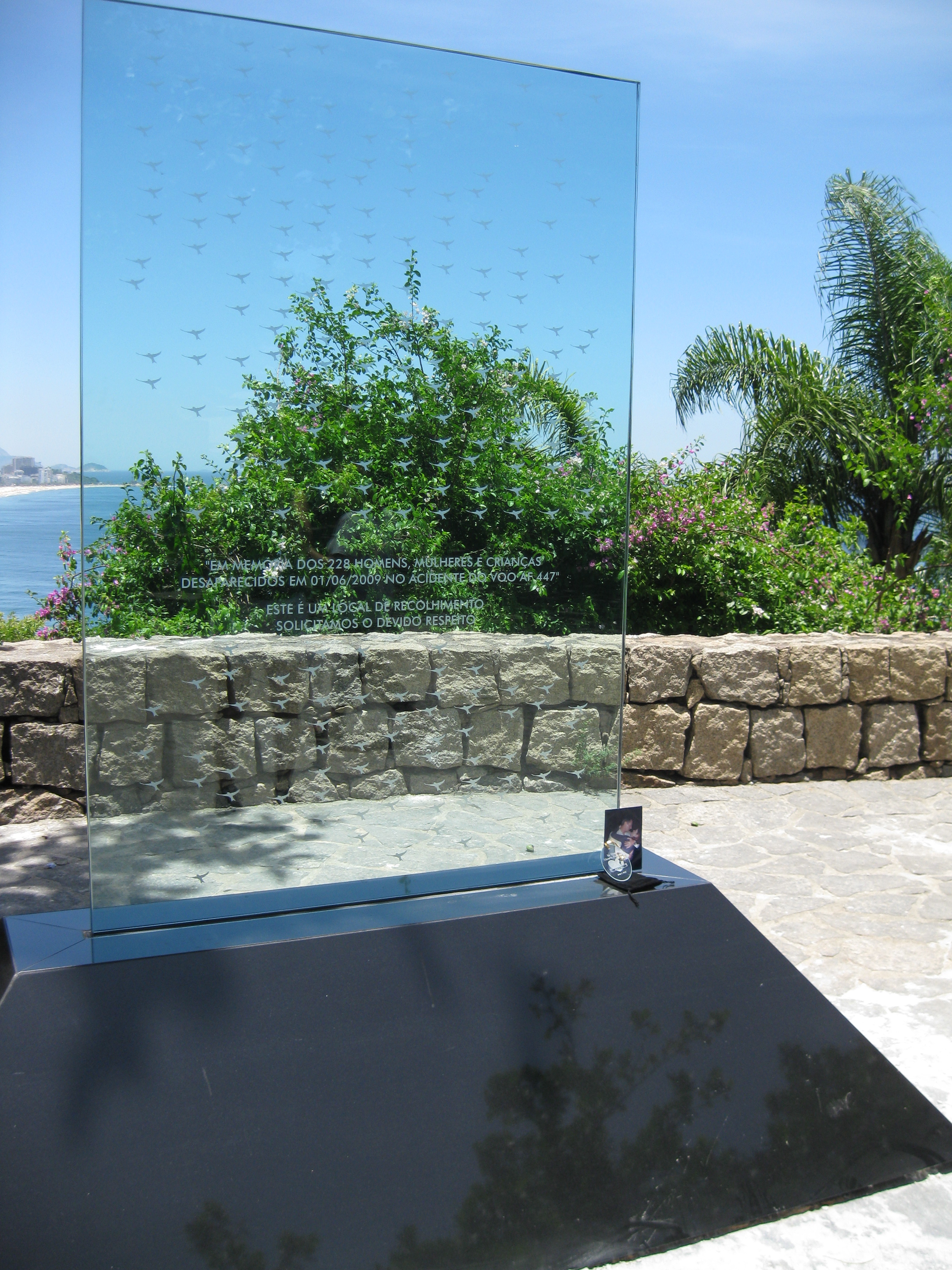
Two similar monuments on opposite sides of the Atlantic memorialize the lives lost. One monument is located in the Pere-Lachaise cemetery in Paris. The largest cemetery in Paris at 119 acres, this elegant cemetery holds the last earthly remains of thousands of souls, many the most famous in French and world history. Outside of Rio de Janeiro, on an ocean site facing the direct route to Paris, stands a similar monument. Both monuments feature an etched glass pane with 228 birds flying on the panes. The panes rest on black granite bases which list the names of all 228 lives lost. The etched glass contains the specifics of the accident and the home countries of the dead.

The location of the two monuments is both obvious and fortuitous. While they include the departure point and intended destination of Air France 447, these sites assure that thousands every year will visit the monuments. The symbolism of the birds on the glass panes is quite beautiful and meaningful – while the earthly lives of the crew and passengers of Air France 447 may have ended in the Atlantic Ocean, their souls have taken flight to their ultimate destinations.

79722349-air-france2011-05-16-IMG_79846a00e5518fa2ad8834012875bd37a4970c